
How to Choose a Mop and Bucket
12 October 2026 · Jessica Gao
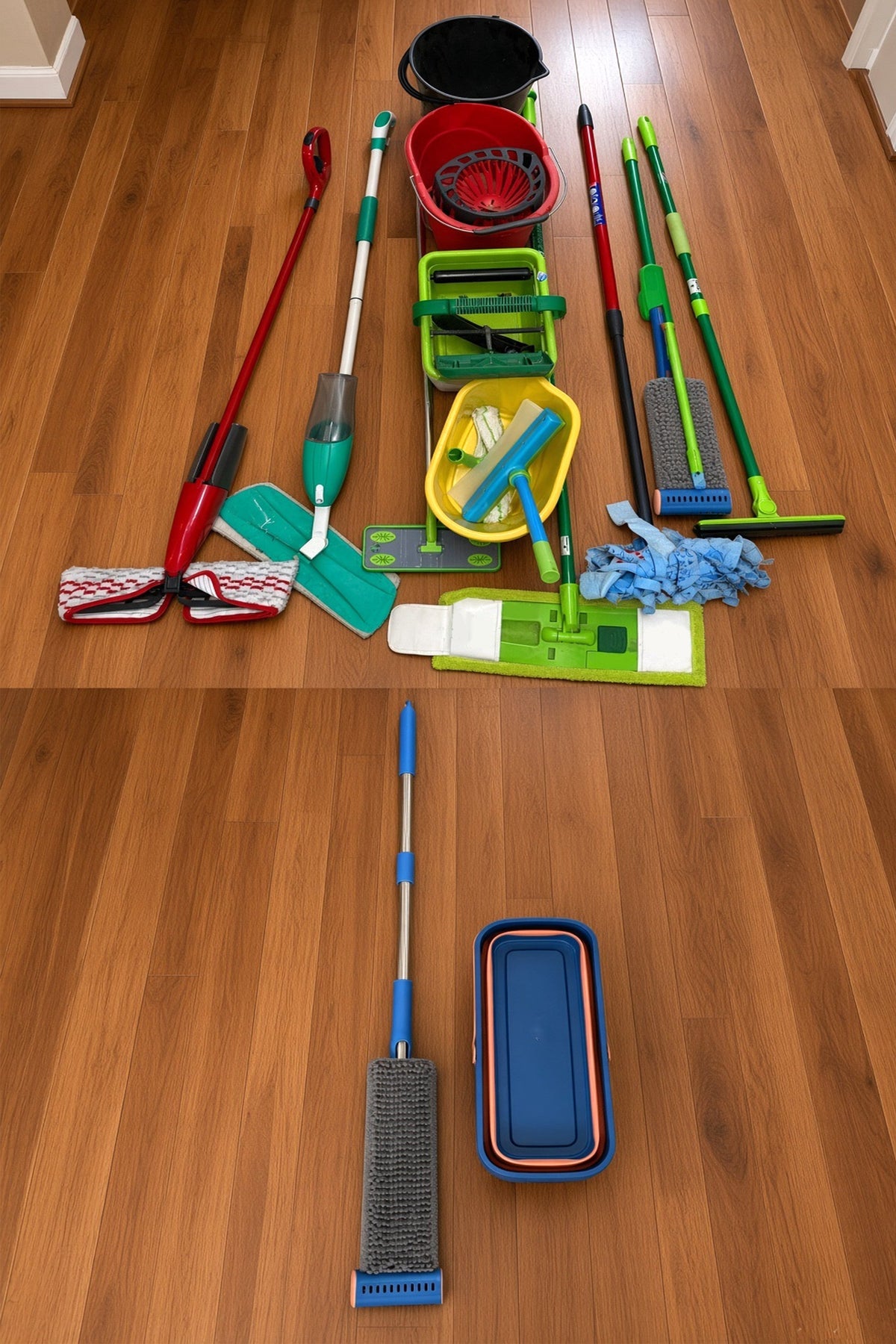
A mop and bucket looks like the simplest thing in the cleaning cupboard. But the wrong combination means sore hands, a floor that stays wet for ages, or a bucket that never quite fits anywhere. Here's how to choose a mop and bucket that suits your floors and your home.
Start with your floors
What you're mopping decides how much water the mop should put down.
- Sealed timber, laminate and hybrid want a mop that's barely damp. Standing water can get into joins and make boards swell.
- Tile, stone and concrete cope with more water, and grout lines reward a mop that can scrub a little.
- Vinyl sits in between: damp is fine, puddles aren't.
- Carpet and rugs need a vacuum, not a mop.
If you have a mix, choose for the most delicate floor. It's easier to add water on tile than to take it off timber.
How does it wring?
This is the part that decides whether you enjoy mopping or dread it.
- By hand. Cheap, but your hands go into dirty water every time.
- Press or roller wringer. Built into the bucket. Push down a lever or handle to squeeze the mop.
- Spin basket. The mop head spins in a basket to throw water out, usually with a foot pedal or by pumping the handle.
- Scraper slot. Used with flat mops. You pull the pad through a slot and the scraper squeezes the water out.
The less you have to bend and the less you touch the water, the more likely you are to mop often.
What kind of mop head?
- Cotton string mops hold a lot of water. Good for big, wet jobs, heavy to wring.
- Round microfibre heads (common on spin mops) are lighter and dry faster.
- Flat microfibre pads reach under furniture and along skirting boards, and come off for the washing machine.
Our comparison of flat, spin and string mops goes into each type.
What about the bucket?
- Big enough for the mop head, with room to rinse it without slopping.
- A proper handle, because a bucket of water is heavy.
- Easy to empty and rinse. Corners and fold lines are where grime hides.
- Rigid or collapsible. Rigid buckets are sturdy. Collapsible ones fold flat for small laundries.
Where will it live?
Measure the gap before you buy. A mop with a long fixed handle and a round bucket takes up more room than people expect. Our guide to storing a mop and bucket in a small space has ideas for tight laundries.
Can you wash the pads?
Look for machine-washable heads or pads that come off easily. A mop head you can't wash properly starts to smell and puts old grime back on the floor. Our guide on how to clean and look after your mop covers the routine.
A quick checklist
- Suits your most delicate floor
- Wrings without your hands in the water
- Head reaches under furniture and into corners
- Pads or head come off for the wash
- Bucket is easy to carry, empty and rinse
- Fits where you'll store it
Where Cleanmatic fits
The Cleanmatic 8-in-1 flat mop and bucket set covers the wringing, reach and storage points on that list: a 42cm flat microfibre pad that wrings itself when you pull it through the bucket's double scraper, a built-in reservoir that feeds detergent to the pad, and a bucket with a carry handle that collapses flat once it's dry. Your hands stay on the handle. See how our mop and bucket works.
Frequently asked questions
What's the best mop for hybrid floors?
A flat microfibre mop you can wring until it's barely damp, so water stays out of the click joints. Our guide to the best mop for hybrid floors goes into the details.
What size bucket do you need?
One the mop head fits into with room to rinse it properly. For a flat mop, that means a bucket shaped to the head's width, so the whole pad gets rinsed and wrung evenly.
How long should a mop and bucket last?
With care, the bucket and handle last for years. The pads or heads are the parts that wear out, so check that replacements are easy to buy before you choose a set.
Related guides: Best mop for hybrid floors · Best mop for tiles · Spin mop vs flat mop