
Spin Mop vs Flat Mop: Which Is Best for Your Floors?
05 October 2026 · Jessica Gao
Spin mop or flat mop? Both clean hard floors well, but they handle water very differently, and on Australian floors that matters more than most people expect. Here's how they compare, where string, spray and steam mops fit, and which one suits your floors.
The short answer
If most of your home is hybrid, vinyl plank, laminate or timber, choose a flat microfibre mop. It cleans with less water, gets into corners and slides under furniture. A spin mop is a good, budget-friendly choice for tiles and large open areas where a little extra water isn't a problem. String mops suit rough outdoor and commercial surfaces, spray mops suit quick touch-ups, and steam mops are best kept to sealed tiles.
What are the main types of mop?
- Spin mop: a round head of microfibre strands that you spin in a basket in the bucket to remove water.
- Flat mop: a flat, rectangular head with a removable microfibre pad.
- String mop: a head of cotton or synthetic strands, wrung out by hand or in a press.
- Spray mop: a flat mop with a built-in bottle that sprays cleaner onto the floor.
- Steam mop: an electric mop that heats water into steam.
Spin mop vs flat mop: side by side
| Spin mop | Flat mop | |
|---|---|---|
| How you wring it | Pedal or pump the handle to spin the head in a basket | Pull the pad through scrapers (self-wringing), or wring the pad by hand |
| How wet the pad gets | Depends on how long you spin; often damp to fairly wet | Easy to control; self-wringing models go from damp to nearly dry |
| Corners and skirting boards | Round head struggles to reach corners | Square edges reach corners and run along skirting boards |
| Under furniture | Head stands tall | Head swivels and lies flat under sofas and beds |
| Floor covered per pass | Smaller, round footprint | Wide head covers more floor in each stroke |
| Cleaning the head | Twist off and wash; strands can tangle and hold hair | Peel off the pad and put it in the washing machine |
| Storage | Round bucket that usually doesn't fold | Slim head; some buckets fold flat |
How a spin mop works
You dip the round head into the water side of the bucket, move it to the spinner basket, then press a pedal or pump the handle. The longer it spins, the drier the head gets.
What's good:
- Wringing is quick and your hands stay out of the water.
- The strands are good at lifting larger mess on tiles.
- Spin mops are easy to find and usually affordable.
What to watch:
- The round head misses corners and edges.
- It's easy to leave too much water on the floor, which hybrid, laminate and timber don't like.
- Strands can trap hair and grit, and need a good rinse after each clean.
- The buckets are bulky to store.
How a flat mop works
A flat mop has a rectangular head, often around 35 to 45 cm wide, with a microfibre pad attached. Microfibre's fine fibres trap dust, hair and crumbs, so the pad only needs to be damp to clean well. Some flat mops come with a bucket that wrings the pad for you.
What's good:
- Covers more floor per stroke, so the job is faster.
- Reaches corners, skirting boards and under furniture.
- Uses very little water, which is what floating floors need.
- Pads are machine washable and cheap to replace.
What to watch:
- Pads need washing after each clean.
- A basic flat mop without a wringing bucket means wringing pads by hand or relying on a spray.
- On deeply textured tiles, strands can get into grooves a little better.
What about string, spray and steam mops?
String mops
String mops hold a lot of water, which is useful on large, rough surfaces like garages, outdoor pavers and commercial floors. Indoors, they're hard to wring damp enough for floating floors, and a head that stays wet can start to smell.
Spray mops
A spray mop is handy for quick touch-ups, like a spill in the kitchen. The catch is that there's no bucket to rinse the pad, so on a full clean the pad gets dirty and starts pushing grime around.
Steam mops
Steam mops work on sealed, glazed tiles. Many timber, laminate and hybrid flooring makers advise against them, because heat and moisture can get into the joins and may affect your warranty. Check your flooring warranty first, and see our guide on how to mop timber floors.
Which mop is best for your floor?
| Floor | Best mop | Why |
|---|---|---|
| Glazed and porcelain tiles | Flat mop or spin mop | Both work; a flat mop with a squeegee edge helps avoid streaks |
| Hybrid and vinyl plank | Flat microfibre mop | Very little water, so moisture stays out of the click joints |
| Laminate | Flat microfibre mop | Laminate edges swell if water sits on them |
| Sealed timber | Flat microfibre mop, barely damp | Timber needs the least water of any floor |
| Polished concrete | Flat mop or spin mop | Hard-wearing; a wide flat mop covers big areas faster |
| Garage and outdoor pavers | String mop | Holds plenty of water for rough surfaces |
For more detail, see our guides to the best mop for hybrid floors and the best mop for tiles.
What should you look for in any mop?
- An easy way to control dampness. Damp, not wet, is right for most floors.
- A head that swivels and lies flat. It reaches under sofas and beds.
- Washable pads or heads. You'll clean better with a fresh one.
- Storage. A bucket that folds or a handle that comes apart saves cupboard space.
- Hands out of the water. Wringing by hand is the messiest part of the job.
Is a spin mop and bucket better than a flat mop and bucket?
Neither is better for every home. A spin mop and bucket suits people who like a thick, round microfibre head and a foot pedal or pump to spin it dry, and it handles big, wet jobs on tile well. A flat mop and bucket suits homes with timber, laminate or hybrid floors, where controlling dampness matters, and rooms with lots of corners and furniture to get under. If most of your floors are sealed timber or click-together boards, a flat mop is usually the easier one to keep barely damp.
Where does a self-wringing flat mop fit?
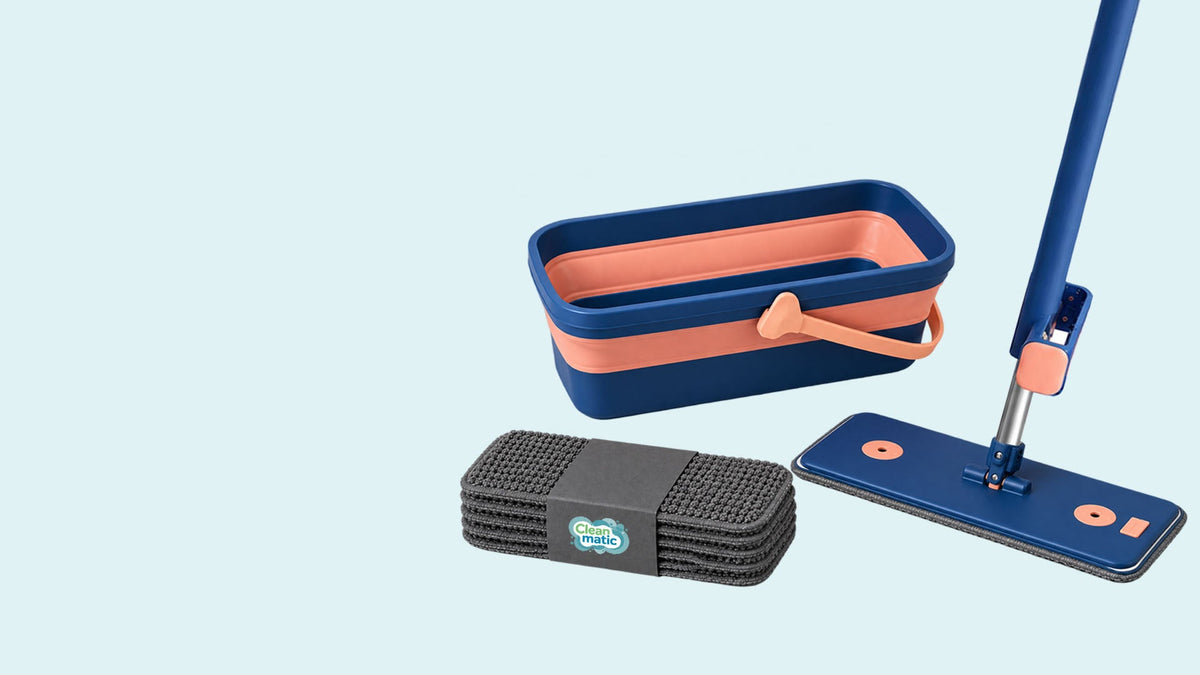
A self-wringing flat mop gives you the hands-free wringing of a spin mop with the wide head and low water of a flat mop. The Cleanmatic 8-in-1 flat mop and bucket set works this way: push the mop into the bucket, pull it back through the double scrapers, and the pad comes out damp and ready. Press once for a damp pad on tiles, or three times for a nearly dry pad on timber.
The 42 cm head swivels 360° to reach under furniture, and the set adds a detergent reservoir, a squeegee edge, a wipe holder and a bucket that folds flat. It comes with 6 machine-washable microfibre pads. Because the head is wide and flat, there's no need to sweep first: the pad picks up crumbs and dust as you go.
Frequently asked questions
Is a flat mop better than a spin mop?
For most Australian homes with hybrid, laminate or timber floors, yes. A flat mop uses less water, reaches corners and lies flat under furniture. A spin mop is still a good choice for mostly tiled homes and large open areas, where a little extra water isn't a problem.
Are spin mops good for hybrid flooring?
They can be, if you spin the head until it's only just damp. The risk is leaving too much water behind, which can seep into the click joints over time. A flat microfibre mop makes it much easier to keep hybrid flooring barely damp on every pass.
Do spin mops spread dirty water?
Any mop that goes back into a single bucket picks up some dirty water. Rinse the head well before wringing, and change the water once it turns grey. This applies to flat mop buckets too, so a bucket that's quick to empty and refill helps.
Which mop doesn't leave streaks?
Streaks usually come from too much water, too much cleaner or a dirty pad rather than the mop type. A microfibre pad wrung until just damp, a small amount of cleaner and a fresh pad once it gets grimy leave the fewest streaks. See what to put in mop water.
When should you replace a mop head or pad?
Replace a spin or string mop head once the strands go flat, fray or smell even after washing. Microfibre pads last a long time if you wash them without fabric softener; replace them once they stop picking up dust. Cleanmatic replacement pads are $10 each. Our cleaning and care guide covers washing.
Related guides: How to mop floors properly · Best mop for hybrid floors · Best mop for tiles · How to mop timber floors · Cleanmatic mop and bucket